Customer expectations keep rising: faster answers, seamless handoffs, and consistent support across phone, chat, email, and social channels. At the same time, contact centers face real operational pressure from fluctuating volumes, staffing constraints, and the need to maintain quality. AI for contact center helps bridge this gap by augmenting teams with automation, real-time assistance, and analytics that improve both customer experience and agent effectiveness. When deployed on an omnichannel cloud contact center, these capabilities work seamlessly across all channels, providing a unified experience for both customers and agents.
As organizations expand automation and intelligent routing, understanding AI for contact centers pricing becomes a critical part of the evaluation process. Pricing can vary depending on factors such as the number of users, interaction volumes, AI features enabled, and whether the model is subscription-based or usage-based. A clear view of pricing structures helps leaders forecast costs accurately, align investments with performance goals, and ensure that efficiency gains translate into measurable ROI.
This guide explains what contact center AI is, where it delivers the most value, and how to implement it in a way that drives measurable outcomes.
What “AI for contact center” means (and what it does)
Contact center AI refers to a set of technologies that understand and generate language, predict outcomes, route interactions, assist agents in real time, and automate repetitive work. This approach is a key example of ai for contact centers in action. In practice, it often combines:
- Natural language processing (NLP) to understand intent, topics, and sentiment.
- Speech recognition to transcribe calls and enable voice analytics.
- Generative AI to draft responses, summarize conversations, and guide next steps.
- Machine learning to forecast volumes, predict customer needs, and optimize routing.
Rather than replacing the human element, the highest-impact deployments focus on assistance (helping agents do great work faster) and smart automation (handling simple tasks end-to-end while escalating complex cases to humans), which is why ai contact center software has become a critical part of modern support operations.
Why contact centers adopt AI: the outcomes that matter
When implemented thoughtfully, AI can improve performance across the metrics leaders care about: speed, quality, consistency, and cost-to-serve. These outcomes highlight the value of contact center ai software in transforming customer experiences. Typical benefits include:
- Faster resolutions through better routing, real-time guidance, and instant access to knowledge.
- Higher customer satisfaction thanks to consistent answers and reduced effort.
- Lower agent workload by automating after-call work and repetitive steps.
- Better quality and compliance using automated monitoring and structured summaries.
- Scalable support across channels without a one-to-one increase in headcount.
The biggest wins usually come from combining several capabilities (for example, transcription + agent assist + automated wrap-up) rather than deploying a single tool in isolation, showing why AI is becoming indispensable in modern contact centers.
Top AI Solutions for Contact Centers
AI is transforming contact centers by automating repetitive tasks, improving agent performance, and delivering personalized customer experiences. From intelligent routing and virtual agents to real-time analytics and sentiment detection, AI is revolutionizing customer service. Here are the leading AI solutions for contact centers:
1. Bright Pattern — Best Overall AI Contact Center Solution
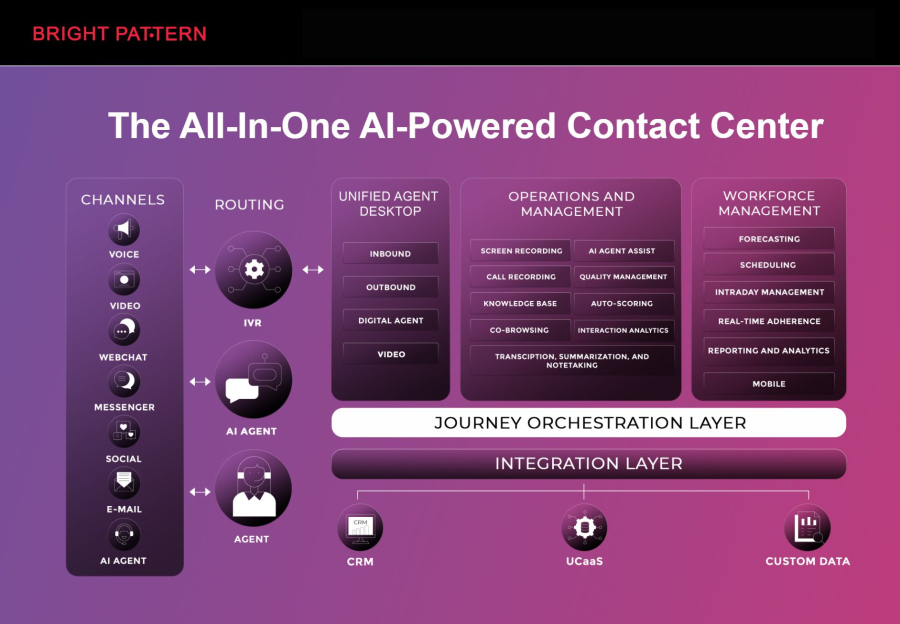
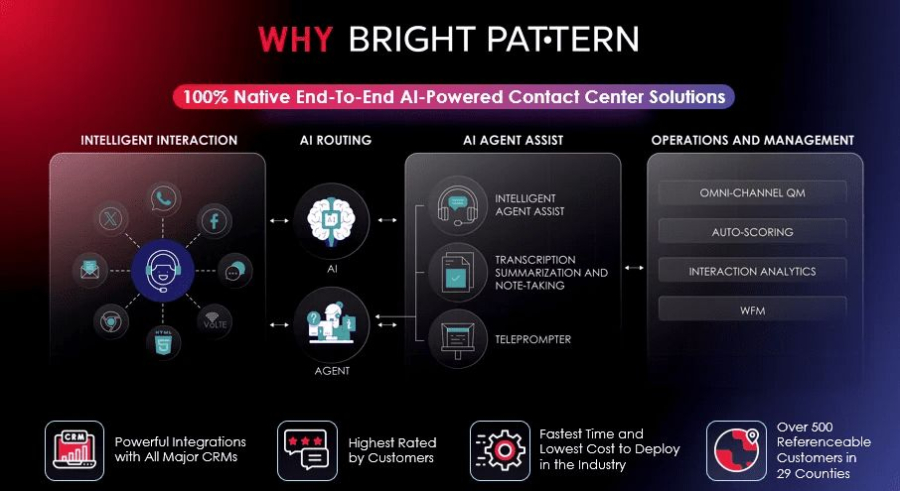
Bright Pattern is a comprehensive AI-powered contact center platform offering omnichannel support, intelligent automation, and real-time agent assistance.
Key Features:
- AI virtual agents for self-service tasks like FAQs and appointment scheduling
- Intelligent routing that matches customers with the right agent based on skills, context, and sentiment
- Omnichannel support: voice, chat, email, SMS, messaging apps
- Real-time agent assistance with next-best-action suggestions
- Highly configurable workflows for enterprises
- Enterprise-grade security and compliance
Bright Pattern enables businesses to deliver consistent, efficient, and human-centric customer experiences.
2. Genesys Cloud CX
Genesys Cloud CX leverages AI for predictive engagement, intelligent routing, and customer journey analytics. It is ideal for organizations looking to optimize omnichannel support and enhance customer insights.
3. NICE CXone
NICE CXone integrates AI into workforce optimization, automation, and analytics. Its real-time sentiment analysis helps improve agent effectiveness and customer satisfaction.
4. Talkdesk AI
Talkdesk AI provides real-time agent support, automated workflows, and industry-specific solutions. It’s known for fast deployment and seamless integrations.
5. Amazon Connect
Amazon Connect uses AI services like Amazon Lex and Contact Lens to provide speech recognition, virtual agents, and sentiment analysis, enabling scalable cloud-native engagement.
6. Zendesk AI
Zendesk AI improves workflows with conversational bots, knowledge base suggestions, and AI-assisted responses, helping teams deliver faster and more accurate support.
7. Microsoft Dynamics 365 Customer Service
Microsoft Dynamics 365 combines AI with CRM to provide virtual agents, predictive insights, and real-time guidance, perfect for organizations already using Microsoft tools.
8. Google Cloud Contact Center AI (CCAI)
Google CCAI delivers AI-powered virtual agents, real-time agent assistance, and speech-to-text analytics. It is highly customizable and suitable for technical teams seeking tailored solutions.
9. Salesforce Service Cloud + Einstein AI
Salesforce Einstein enhances Service Cloud with AI-driven case routing, predictive recommendations, and smart automation, ideal for Salesforce-integrated organizations.
10. Five9 Intelligent Cloud Contact Center
Five9’s AI tools include virtual agents, smart IVR, and agent assist capabilities, helping businesses move from traditional call centers to AI-enhanced cloud contact centers.
High-impact AI use cases in the contact center
AI can support the entire customer journey, from the first contact to post-interaction follow-up. Here are the use cases that most consistently deliver value.
1) Intelligent self-service and virtual agents
Virtual agents (chatbots and voice bots) can handle common requests such as order status, password resets, appointment scheduling, and policy questions. The goal is not to “deflect at all costs,” but to provide quick, accurate answers and smooth escalation when human help is needed.
- 24/7 availability for routine questions and transactional requests.
- Consistent responses based on approved knowledge sources.
- Seamless handoff to agents with context preserved (customer details, intent, steps already taken).
2) Smarter routing and prioritization
Traditional routing often relies on IVR menus, basic skills, and queue order. AI-enhanced routing can add more context such as intent, language, customer history, and predicted complexity to connect customers with the best-fit resource faster.
- Intent-based routing to the right team on the first try.
- Priority handling for time-sensitive or high-impact issues based on defined policies.
- Reduced transfers by matching complexity to agent expertise.
3) Real-time agent assist during calls and chats
Agent assist tools listen (or read) in real time and provide relevant prompts, knowledge articles, suggested replies, and next-best actions. This is especially valuable for new agents, complex products, and policy-heavy environments.
- In-the-moment guidance so agents don’t have to search multiple systems.
- Faster ramp-up for new hires with contextual support.
- More consistent experiences across agents and shifts.
4) Automated transcription, summaries, and after-call work
Call transcription and AI-generated summaries help reduce manual note-taking and speed up wrap-up. When summaries are structured (issue, troubleshooting steps, resolution, commitments), they also improve downstream processes like case management and follow-ups.
- Shorter handle times by reducing repetitive documentation.
- Better continuity when cases transfer or customers recontact.
- Cleaner data for analytics and process improvement.
5) Quality assurance (QA) and compliance at scale
Manual QA typically samples a small percentage of interactions. AI can analyze a much larger set of calls and chats to identify coaching opportunities and compliance risks.
- Broader coverage across channels and teams.
- Targeted coaching based on specific behaviors and conversation patterns.
- Faster detection of trending issues and policy deviations.
6) Voice of the customer and conversation analytics
By extracting intents, topics, and recurring pain points, AI-powered analytics can reveal what customers are asking for, where they get stuck, and which product or policy issues create repeated contacts.
- Trend discovery to reduce avoidable contact drivers.
- Better knowledge management by identifying gaps in articles and scripts.
- Cross-functional insights for product, billing, logistics, and digital teams.
7) Workforce optimization with better forecasting
AI can improve forecasting by incorporating historical patterns, seasonality, campaign data, and real-time signals. More accurate forecasting supports better staffing decisions and smoother service levels.
- More stable service levels during peaks and unexpected spikes.
- Reduced burnout through more predictable workloads.
- Smarter scheduling aligned to channel demand and skills.
A quick mapping: AI capability to contact center benefit
| AI capability | Where it fits | Primary benefit |
|---|---|---|
| Virtual agents (chat / voice) | Pre-agent and simple requests | Faster answers and 24/7 coverage |
| Intent detection and routing | Queue entry and transfers | Higher first-contact resolution |
| Real-time agent assist | Live calls and chats | Improved speed and consistency |
| Transcription and summarization | During and after interaction | Reduced after-call work and better records |
| Automated QA and compliance monitoring | Post-interaction analytics | Better coaching and risk detection |
| Conversation analytics | Operations and continuous improvement | Lower repeat contacts and better insights |
What great looks like: practical success patterns
AI value tends to compound when teams align technology, process, and people. The following success patterns are common in high-performing contact centers:
- They start with a clear workflow: picking a repeatable use case such as post-call summaries or top-10 chat intents before expanding.
- They connect AI to trusted knowledge: ensuring suggested answers come from approved articles, policy docs, and up-to-date product information.
- They keep humans in control: using agent review and customer-friendly escalation paths for nuanced issues.
- They build feedback loops: capturing agent feedback on suggested responses to continuously improve relevance.
- They measure outcomes: tracking operational metrics and customer experience indicators before and after rollout.
These patterns help AI feel less like a “tool rollout” and more like a continuous capability that improves service quality over time.
Key metrics to track when adopting AI
To keep implementation focused and persuasive across stakeholders, tie each AI capability to specific metrics. Common measures include:
- Customer experience: CSAT, NPS (where used), customer effort signals, sentiment trends.
- Efficiency: average handle time (AHT), after-call work time, containment rates for self-service, deflection where appropriate.
- Effectiveness: first-contact resolution (FCR), transfer rate, repeat contact rate.
- Quality: QA scores, compliance adherence, accuracy of summaries and dispositions.
- Agent experience: time-to-proficiency for new agents, attrition indicators, internal satisfaction surveys.
For the cleanest read on value, define a baseline period, run a pilot with a comparable control group if possible, and report improvements by channel and intent type.
Implementation roadmap: how to introduce AI without disruption
A structured rollout makes adoption smoother and speeds time-to-value.
Step 1: Choose a high-confidence starting point
Pick a use case with strong repetition and clear definitions, such as:
- Automated interaction summaries
- Suggested replies for chat
- Intent-based routing for top call drivers
- Virtual agent for a small set of FAQs and transactional flows
Step 2: Prepare knowledge and data foundations
AI performs best when it can reference accurate, current information. That means:
- Defining approved knowledge sources and owners
- Cleaning up duplicated or outdated articles
- Standardizing disposition codes and case categories
Step 3: Design the agent experience
AI should reduce friction, not add it. Strong designs typically include:
- Clear UI placement for suggestions and next steps
- Easy acceptance or editing for drafted responses and summaries
- Low-noise recommendations to avoid overwhelming agents
Step 4: Pilot, learn, and expand
Run a pilot with a defined group, compare against baseline, and iterate. Expansion tends to be most successful when you:
- Roll out by intent clusters (billing, returns, technical setup)
- Expand from one channel to adjacent channels (chat to email, then voice)
- Build reusable components (knowledge connectors, routing logic, summary templates)
Common AI features buyers look for in contact center platforms
Whether you’re adding AI to an existing stack or evaluating a broader platform, these capabilities often drive results in day-to-day operations:
- Omnichannel support (voice, chat, email) with consistent context
- Real-time and post-interaction analytics for coaching and trend insights
- Configurable automation for workflows like authentication, status checks, and case updates
- Knowledge integration with governance for accuracy and approvals
- Role-based controls for supervisors, QA teams, and admins
How AI strengthens both customers and agents
One of the most compelling aspects of AI in the contact center is that it can create a win-win dynamic:
- Customers get quicker, more consistent answers and fewer transfers.
- Agents spend less time searching, typing notes, and repeating steps, and more time solving meaningful problems.
- Leaders gain clearer operational visibility and scalable quality improvements.
In practice, this can turn the contact center into a strategic advantage: a place where customer needs are understood quickly, problems are resolved efficiently, and insights flow back into the business to prevent future contacts.
Next steps: choosing the right first AI project
If you’re deciding where to begin, a simple framework is to prioritize initiatives that are frequent, well-defined, and measurable. For many teams, that means starting with transcription + summaries or agent assist for the highest-volume intents, then expanding into smarter routing and self-service once knowledge and workflows are well established.
With the right focus, AI for contact centers becomes a practical, step-by-step path to better service: faster responses, higher consistency, and more empowered agents who can deliver great experiences at scale.
